Notes on John Wick: Chapter 3 (2019)
The particular brand of pop cinema that Stahelski and his team pull off here is something that you can’t find anywhere else, and in a way that makes John Wick: Chapter 3 – Parabellum one of the best modern action movies of its kind. That it is still a decidedly flawed movie may speak to the lack of great work being done in that sphere by Hollywood filmmakers, but it also shouldn’t deter appreciation by what it gets right.
by Willa Ross
Sure, you can make the case that the John Wick movies — his entire filmography to date — aren’t ideal uses of Chad Stahelski’s talent, but as far as the setup and execution of car chases, gunfights, knife fights, and kung fu battles, I don’t think there’s many ways to fault him for lacking competence or creativity. The particular brand of pop cinema that Stahelski and his team pull off here is something that you can’t find anywhere else, and in a way that makes John Wick: Chapter 3 – Parabellum one of the best modern action movies of its kind. That it is still a decidedly flawed movie may speak to the lack of great work being done in that sphere by Hollywood filmmakers, but it also shouldn’t deter appreciation by what it gets right, and what it gets so, so right is its ability to economically introduce interesting fight scenarios and then capitalize on them with panache.
The plot reconfigures the rules and stakes from the last chapter, but still feels very much of a formula: Reeves is back as John Wick, the former assassin who took revenge on a low-level mobster for killing the puppy his wife had delivered to him just after her death, setting off a chain of resentment and attempts of payback all the way up to the “High Table”, a council of the most powerful criminals in the world who have a text message to every criminal in the world that they should kill John Wick, or at the very least not help him. Enforcing the will of that council is the “Adjudicator”, a brusquely direct emissary who informs those who have displeased the high table (usually by helping John Wick) that they have to accept punishment in the form of a bunch of scarring sword slices or having their hands stabbed or being fired. I’m not sure why she doesn’t just have them killed, which crime bosses tend to do to avoid having maimed or humiliated underlings turn against them, but I’m not gonna raise too much of a stink about a premise that is openly ridiculous in the first place. I wish the plot of these movies made more sense, but it rarely gets in the way of the action.
That’s similarly the biggest compliment you can pay to the music, which, to be 100% clear, is me damning it with faint praise. While Tyler Bates and Joel J. Richard once again avoid the overwhelmingly generic rock beats ‘n’ guitar chords of the first film by using a broader palette of electronic rhythms and ambiences, the music remains frustratingly limited in its development and tonal flexibility. The main theme in particular has received virtually no meaningful embellishment over the course of three movies now, which particularly stings given it was never a complex or especially expressive theme to begin with. One could argue that John Wick himself isn’t the most dynamic character, but that’s no excuse for this kind of musical inertia. It certainly doesn’t stop the film’s other craftspeople from trying new things elsewhere.
(A sidebar on a particularly annoying aspect of the score: The single most interesting musical decision in the film is the use of the first Winter movement from Vivaldi’s Four Seasons. Unlike the second film’s Vivaldi cue, which used a heavily electronic remix of the third Summer movement, the use of Winter I here is a straightforward orchestral performance of the original composition, which works terrifically well to create a chilled sense of foreboding. Confusingly though, rather than changing to an action-movie styled take on the movement or using the fast-paced third Winter movement, once the fighting starts the soundtrack reprises that same damn Summer electronic piece from Chapter 2, a nonsensical choice that once again foregrounds what an ineffective redo it was. Given that the credits feature a similar remix of Winter I, it seems like a safe assumption that Stahelski was unsatisfied with the new cue, opted to reuse the old piece, and stuck Bates’s and Richard’s take on “Winter” in the credits. I can’t entirely blame him, since the piece heard in the credits once again scuttles the rhythmic glories of Vivaldi’s piece and uses a dull electronic arrangement, but undercutting the continuity of the musical concept by using the reprise was at least as bad a choice, especially when it meant reusing a cue that wasn’t good to begin with.)
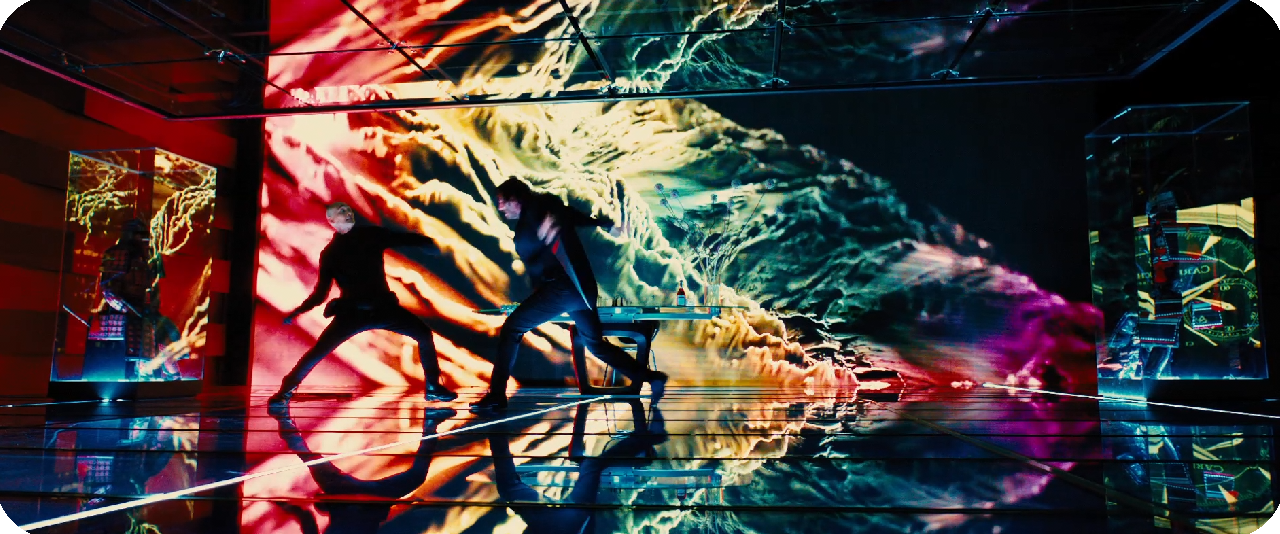
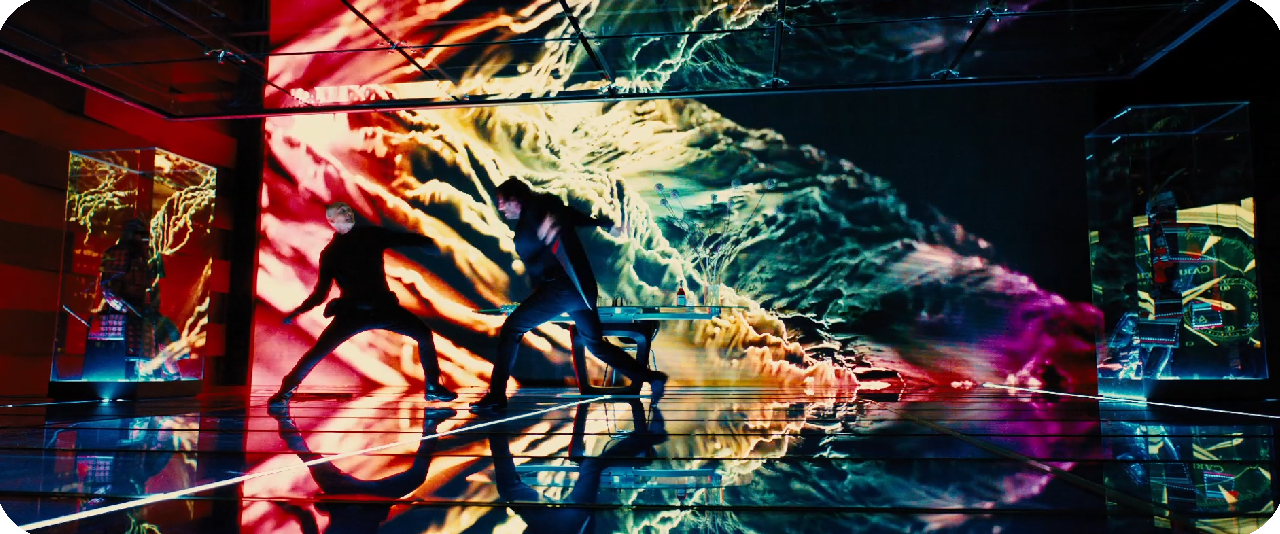
Just as Bates and Richards earn the same criticisms, every positive thing I said about Dan Laustsen’s cinematography in the last one applies here (though sadly this time Kevin Kavanaugh’s production design finds less opportunities for those ornate parodies of locations). Laustsen’s work in this series is a highlight of the 2010s’ neon revival, tremendously baroque with its placement of coloured lights and shadows and thoughtful in its scope framing, assisted by Stahelski’s marvelous gift for camera direction, which is more consistent here than ever, both in the loud and quiet parts. That goes for the loud parts especially though; the clearness of the staging belies the complexity and precision of the camerawork here. In particular, one sequence involving two gunfighters fighting alongside two dogs makes incredible use of the camera to establish the lateral space and track how quickly and efficiently the dogs can close that distance while keeping everyone’s position’s clear in any given moment. A John Wick movie could work with a lot of parts or personnel shuffled around, but it’s hard to imagine one this good without Stahelski and Laustsen behind it.
While John Wick mostly confined itself to superlative displays of driving and gun fu from Reeves and Chapter 2 added interest by setting up his limitations and making more extensive use of the fight settings, Chapter 3 blows elevates the series to new levels of complexity and invention. There are multiple action sequences in Parabellum that take unusual premises (fighting in a stable full of horses, fighting in a room full of antique bladed weapons behind glass, fighting goons who are so heavily armoured that the only way to actually kill them is by walking up, opening their helmets’ visors, and shooting into them) and explore every logical avenue imaginable and, most delightfully, many I didn’t imagine at all. One of the most relieving things about this is just how funny the action is, how almost every fight indulges over and over in those Buster Keaton-esque setups and payoffs, those logical extremes that shock you, but at the same time make complete sense for the characters and their situation. While the last two or three fight scenes lack this sense of humour on account of being standard melee combat, they are at least excellent melee combat, if a bit of an anti-climax (made all the more familiar by an obvious nod to the structure of Game of Death). The only real complaint I have is that the sound design, while mostly terrific, is a little overeager to make every impact a thooming, bone-crushing smash, which makes it hard to distinguish the big hits from the really big hits. You can’t go up from 10, as they say.
One way that Parabellum achieves such diverse action scenarios is by leaning harder into an episodic story structure than either of the Wicks before it. On one hand, this means that dramatic development is extremely minimal, as characters tend to show up, have their personal conflicts introduced, and then either be killed outright or be shown the door for potential reuse in a sequel. By traditional standards of feature film storytelling, this is a problem; here, though, quickly sketched, entertaining characters are entirely suited to economically setting up the conditions and stakes of the next big rumble. I don’t think I’d go so far as saying it’s a good script — the writing is mostly boilerplate as usual, the rules of the universe are still a bit arbitrary and inconsistent, and the material is primarily elevated by the cast’s more over-the-top performances and Stahelski’s direction — but Derek Kolstad has sanded off a lot of the issues that his scripts caused for the first two movies. This time around his most unforgivable sin is having Keanu Reeves deliver a weightless nostlagia-boom for fans of The Matrix by having him say, “Guns, lots of guns”. I mean come on, man. We’re all aware he was Neo.
After three movies of insanely brutal carnage, though, it probably behooves one to, uh, think about violence for a second. What, after all this, almost six hours of headshots and flipping people over and smashing vehicles, does it all mean? The easy (and filmmaker-intended) answer is “not a thing, it’s a cartoon, enjoy it,” but that feels a little too pat. I’ve seen reactions to John Wick: Chapter 3 that chastise it for indulging so gleefully in gun violence, but that feels too exclusionary towards the self-aware cartoonishness that the series has cultivated and improved from one entry to the next (and I do not have the patience to return to a debate about whether violent cartoons are “moral”). Maybe what squash and stretch physics do for the emphatic motion and chaos of Bugs Bunny, brain matter and broken bones do for the John Wick movies; mutual exaggerations of the physical effects of violence. Maybe laughing at most of a head disappearing under a shotgun blast is different than laughing at Wile E. Coyote turning into an accordion. Maybe one is more honest, maybe one desensitizes you less. Maybe it’s okay to have fun in a movie where horrible people who are caricatures of organized criminals in an absurdly implausible global gang hierarchy murder each other in creative ways. Yeah, that last one feels good. Let’s go with that.
Other Essays in This Series
John Wick
John Wick: Chapter 2
John Wick: Chapter 3 – Parabellum
Notes on John Wick: Chapter 2 (2017)
For Stahelski, the new comic point of reference isn’t quite a Looney Tunes cartoon, but Buster Keaton. One of the film’s opening shots focuses on a scene from Sherlock Jr. projected on the side of a Manhattan building. The in-your-face delivery of that influence to the audience reflects a very welcome post-modern playfulness with Chapter 2’s own identity. That identity, for what it’s worth, never successfully resolves, but Chapter 2 imperfectly points a potential path for an action movie whose split personality is half the fun.
By Willa Ross
If this was 2014 and I was allowed to offer one piece of advice to the makers of John Wick for their development of a sequel, it would be to adopt a greater commitment to tone. While that film played with some goofier material and sprinkled in some personal pathos and indulged in some heightened crime drama, its expression of each tended to feel like half-measures, rubber banded to an indistinct center whose emotional heft was murkier than the film’s needlessly low-contrast photography. The crime material offered up hammy line readings but ought to have pushed the juvenilia of its world-building up to the hilt, the mourning and reflection was given time to but rarely aimed for the melodramatic operatics that could make it proportionate to the action-crime-drama material and give it emotional credibility, and Wick’s unfathomable power to survive shootouts with any number of hired guns was given some wry nods, but a force so brutally unstoppable should be less like the Wachowskis’ Neo and more like Chuck Jones’s Road Runner.
For Chad Stahelski (this time directing solo), the new comic point of reference isn’t quite a Looney Tunes cartoon, but arguably the closest thing to it in live action cinema, Buster Keaton, a declaration I’m not making based on careful scrutiny of the film’s stylistic properties but based on the fact that one of the film’s opening shots focuses on a scene from Sherlock Jr. projected on the side of a Manhattan building. While it’s not a comparison that the film always strives for, the influence is felt and appreciated, and the in-your-face delivery of that influence to the audience also reflects a very welcome post-modern playfulness with its own identity. That identity, for what it’s worth, never successfully resolves, but Chapter 2 imperfectly points a potential path for an action movie whose split personality is half the fun.
The opening sequence — where Wick storms a garage serving as a front for the Russian mob — is better than anything in the original. First and foremost, you have Peter Stormare playing the brother of John Wick’s chief antagonist, and his bit part (confined to appearances in a single room in the first 15 minutes) is the best performance in either film. If Michael Nyqvist’s Russian crime boss was slyly parodic, Stormare’s is an abject mockery of the stereotype. Or maybe it’s just an abject mockery of “acting” as a “character” in a “movie”. Either way it’s absolutely hilarious, not just exploiting the humour of the lines as written but pouring excess all over them and singlehandedly breaking the illusion of a contiguous fiction. It’s more syrup than pancake, and I love it.
The opening also announces Chapter 2’s shift in focus in that it is completely irrelevant to the film’s plot. While there is a plot that threads the movie together and it is an entertaining plot, it’s also a lot of nonsense, and by opening with 15 minutes of wholly disconnected action rather than the studious character development of John Wick, Stahelski and returning scribe Derek Kolstad signal heavily that literary levels of dramatic structure are not the point of the plot. The point of the plot is to deliver inventive and well-staged action set pieces and moments that try to make you laugh as hard as Peter Stormare.
The plot, for what it’s worth, involves John continuing his fruitless quest to re-retire from the underworld. Instead he causes an extreme crescendo of pissing powerful criminals off, and gradually seems to accept that this is his life now, just headshotting people who try to kill you until you can get to antagonist du jour and killing him and enjoying a moment of respite before all the people who liked or worked with that antagonist tell everyone they know to kill you. It’s a formula that’s carried over from the first film and would feel stale if it weren’t for the fact that it rises to such crazy heights here; the fact that Wick gets himself into much deeper shit than turning the entire Camorra crime syndicate against him should give you a hint at how giddy this series is about turning almost literally the entire world against him.
That tidal wave of would-be killers translates to an enlarged body count, which means killing a whole lot more people on average in the handful of section pieces that give the movie reason to be. While John Wick’s action sequences derived their success almost entirely from Keanu Reeves’s ability to fluidly launch his body from one position to the next in reaction to his assailants — a quality retained and even enhanced here — Chapter 2 adds numerous elements to give each fight and shootout its own arc. That often entails greater interaction with the environment, as in a hall-of-mirrors sequence that confounds our sense of spatial orientation, or more diverse tactical decision-making, displayed up-front when Wick outfoxes his motorcycle-driving quarry in a car chase by swinging through a route with faster traffic before stopping his car dead in the middle of an intersection, right where the chopper can’t help but slam into the side and send its rider sailing into the concrete.
But the most important and effective way this Wick crafts more satisfying fight scenes is by incorporating a whole lot more table setting. John’s loadout before each fight is introduced in (sometimes laboured) detail, and those setups are paid off amply every time: in one fight his frustration at being given a single pistol with a seven-bullet magazine pays off multiple times as he angrily runs short of bullets, switches guns, throws the cast-offs at his opponents; in another, he removes a piece of kevlar shielding that was sewed into his jacket when he thinks a gunfight is over, only to desperately hold the floppy bullet-proof oval in front of him as he’s ambushed. It’s these logical (and usually comical) extrapolations from Wick’s toolkits, more than anything, that reveals the Keaton influence.
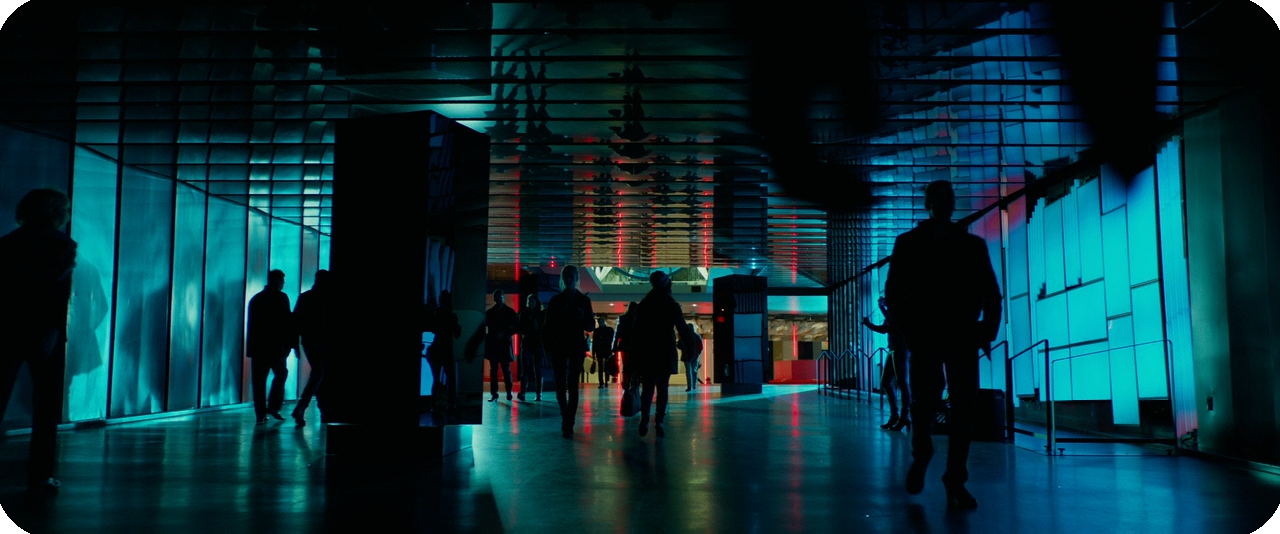
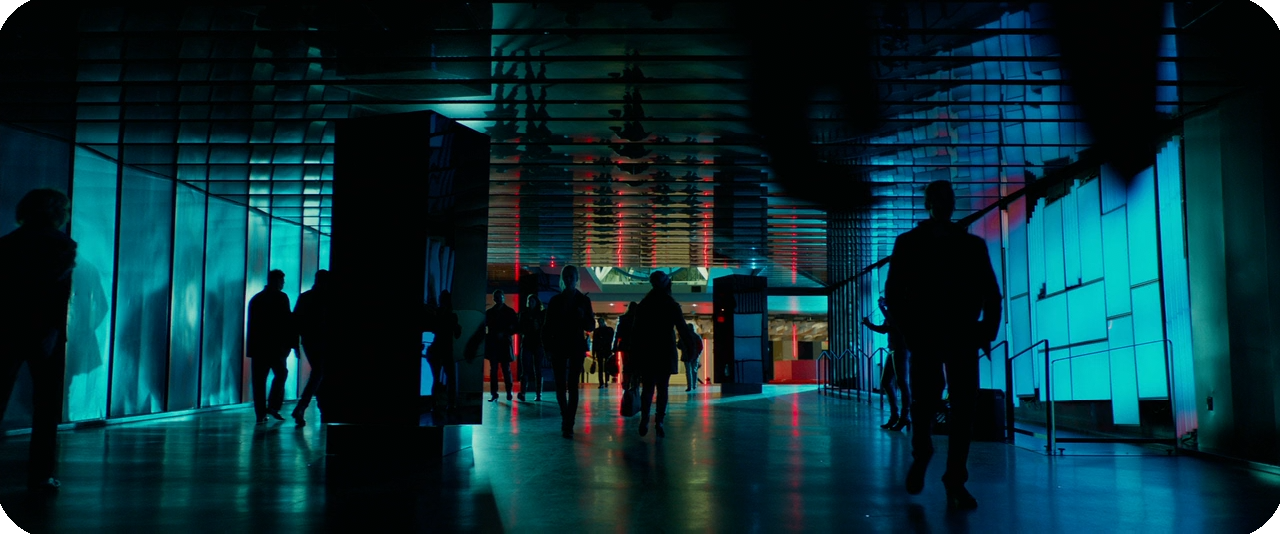
I also have to single out the film for its improvements in music and cinematography, two of the biggest problems with its prequel. While the music by Tyler Bates and new composer Joel J. Richard is only a marginal improvement from the last (thanks mostly to adopting a slightly expanded sonic palette), the cinematography, this time headed by Dan Laustsen, hasn’t just escaped liability; it’s now one of the film’s biggest assets. Laustsen retains the film’s love of colour splashes, ditches the blue and orange filters and low contrast of the last film (there are numerous scenes with neutral skin tones here), and displays a far greater utility with composition than Jonathan Sela’s work last time around. It’s not just a big step up from the cinematography in the last Wick movie I saw, but the last Dan Laustsen movie I saw: the fact that it was the sloppy visuals in The Shape of Water that gathered Laustsen all the accolades in 2017 while his work here received no attention is a prime example of how farcical the Hollywood awards season is. It also helps that the production design — with Kevin Kavanaugh heading that department this time — is lovely and well-tuned to the movie’s aesthetic and sense of humour, full of baroque parodies of the settings — museum, modern art installation, Italian hotel — that both help the film’s comical tone and give a more robust colour arrangement. It’s Kavanaugh’s best work to date, and a great example of a project that gives a production designer room to do something truly unique.
In fact, I could almost say that the improvement on offer here is nearly across-the-board. That doesn’t mean Chapter 2 is flawless, mind you. A little bit of the first film’s half-baked attempts at psychoanalyzing Wick rears its head from time to time (most irritatingly in an excruciating “I think you enjoy this” speech given by the bad guy as he hides around the corner”). There still isn’t much of a sense of palpably rising stakes and heightening tension over the full runtime. And a lot of the dialogue still feels very written, the attempt to be cool coming through much clearer than any actual sense of being cool. The music, while a bit better, is still wallpaper-y at its best and irrirating at its worth (as in a baffling remix of one of the Summer movements from Vivaldi’s Four Seasons that strips out almost all the rhythmic urgency). And finally, I’d be remiss if I said that as of this chapter this series is developing something of a problem with associating its few female characters with sexualized violence, particularly a scene where a character strips nude before slitting her wrists and lying face-up in a pool of water. I’m happy that Kolstad is pushing for more operatic levels of melodrama here, but scenes like that show a thoughtlessness about the approach that I dearly hope changes in Chapter 3, and make the overwhelmingly male crew a lot tougher to swallow.
That, ultimately, is the most telling compliment I can pay to John Wick: Chapter 2: it shows artists committed to improvement and confident enough to deliver an undeniably entertaining pop cinema experience. While I came into John Wick and Chapter 2 with a sense of obligation to stay in the loop about modern action movies, I’m actively excited to go see the new Parabellum chapter later this afternoon and find out what new ideas and improvements these artists have to offer. He may not be the Road Runner, but Wick is definitely starting to really step on the gas here.
Other Essays in This Series
John Wick
John Wick: Chapter 2
John Wick: Chapter 3 – Parabellum
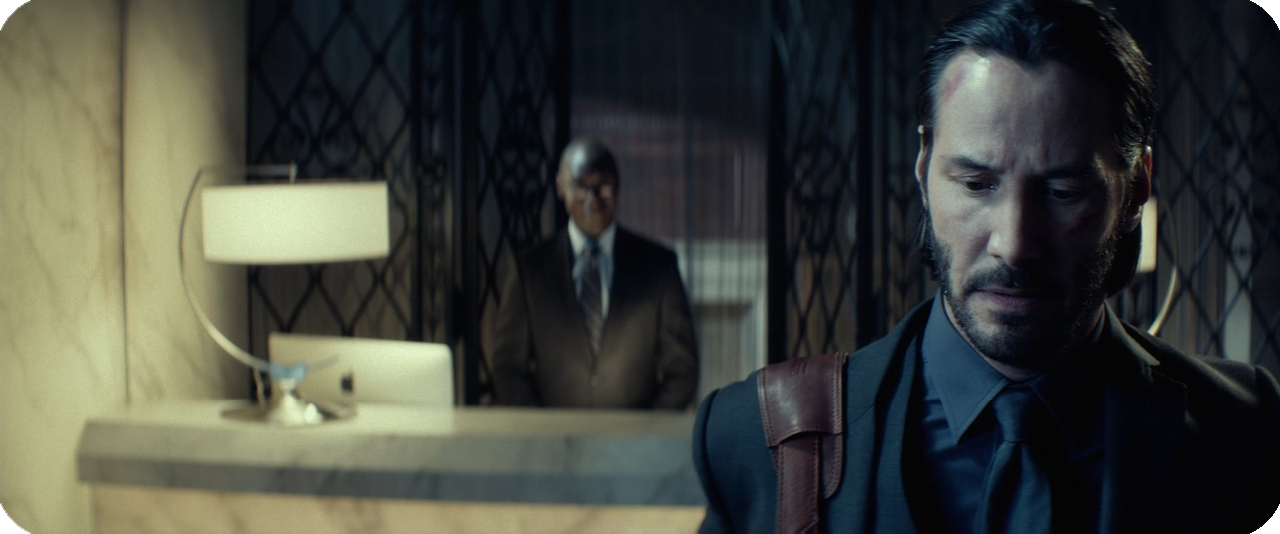
Notes on John Wick (2014)
I can no longer ignore these. Wick, like a lot of action movies that boast technically astonishing fight choreography, is directed by two veterans of stuntwork, Chad Stahelski and David Leitch; the question with auteurs who come into the genre from this direction is whether they are only interested in feature length technical expressions of the craft they practiced outside the director's chair, or whether they're interested in dramatic modulation emotionally resonant aesthetic choices, technique that expresses more than technical strength.
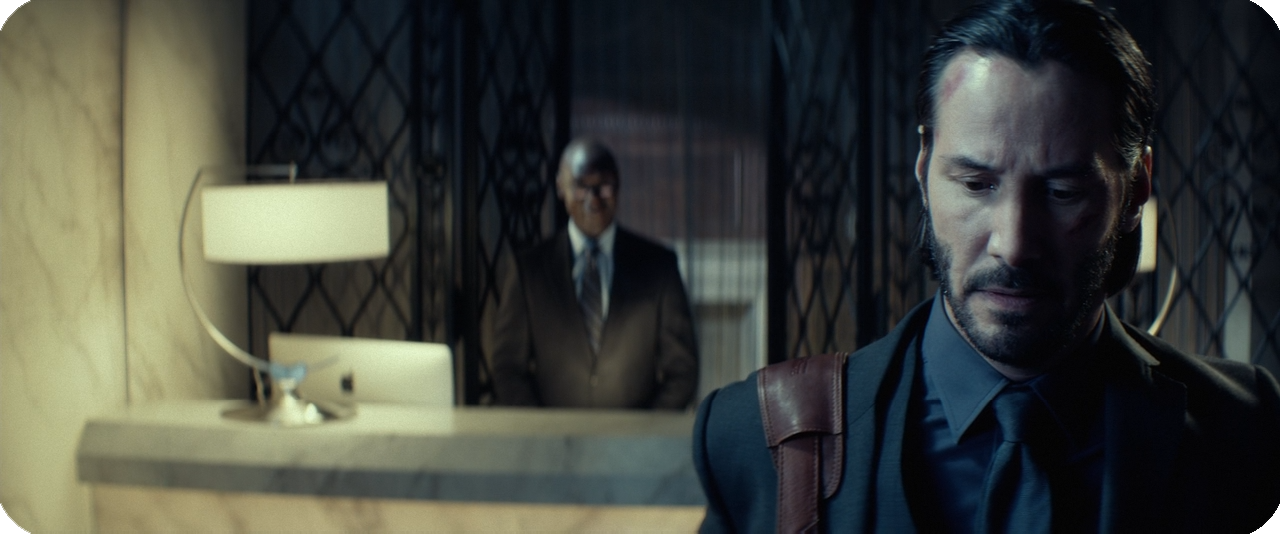
By Willa Ross
For years, I've avoided this, its first sequel, and Atomic Blonde, in large part because the kind of acclaim they received tended to overlap heavily with The Raid 2: Berendal, a film I do not care for. The Raid 2, for my money, is a film interested in intricately choreographed action without character (let alone characters), which frequently takes as its emphasis the physical brutalization and mutilation of the body, with an expectation that this will be played sheerly for laughs. It's a film that crosses the line between a cathartic, escapist enjoyment of carefully staged violence anchored in an emotional context, and a giddy display of pain and technical virtuosity without attempting a structure or sense of progression in each action scene. Descriptions of the John Wicks tended to both explicitly cite The Raid 2 as similar, and describe John Wick in nearly identical terms.
Regardless, like the Raid movies, John Wick and its Chapter 2 sequel have been common in discussions of contemporary action cinema and its exemplars, and as someone who cares very much about the genre and would like to see its potential ways forward outside the Marvel Cinematic Universe, I can no longer ignore these. Wick, like a lot of action movies that boast technically astonishing fight choreography, is directed by two veterans of stuntwork, Chad Stahelski and David Leitch; the question with auteurs who come into the genre from this direction is whether they are only interested in feature length technical expressions of the craft they practiced outside the director's chair, or whether they're interested in dramatic modulation emotionally resonant aesthetic choices, technique that expresses more than technical strength.
The answer is that they do care — in fact, sometimes they seems to care more than their writer Derek Kolstad — though as of this first entry they’re inexperienced hands at showing it. John Wick's action deserves the praise it gets as a technical showcase for Stahelski and Leitch, their stunt team, and Keanu Reeves; it is also, thankfully, an action movie with an interest in how its characters think — not to mention it knows how to tell a fucking joke. The brutality on display here is undeniable, but the film takes its time over around 30 minutes to establish it as an almost abstract metaphor for the title character's rage: rage that, with all the senseless loss and grief that one can endure by chance in life, human beings can also enact cruelty by choice. In John Wick, the thematic locus of that cruelty remains frustratingly abstract; crime-revenge cliche explanations for the senseless pain that Wick endures are trotted out — "the past", "bad luck", "people don't change" — but don't actually find much in the narrative to support them, and tend to come off as a self-serious hodgepodge attempt to simulate emotional grandeur without doing the work for it. Nonetheless, they kill the guy's adorable fucking puppy. There's a dramatic core there to work with. I mean, I don't know about you, but I love puppies.
If Wick embraced that kinda goofy degree of emotional simplicity more, it'd probably do it a lot more good than the way it strains to show import. While I genuinely appreciate the time the film takes to establish Wick as a man suffering terrible grief in the opening sequences, both the writing and direction of these scenes are full of cliches and feel more perfunctory than they clearly intend to, with hardly any inspired moments that establish a genuine connection. (An exception: the puppy wakes up Wick just seconds before his alarm clock buzzes. Awww. I love puppies.)
Regardless, the shot direction, sound, and music of the pre-puppy-killing scenes are thoroughly unimpressive: boilerplate drama without much more to than kinda hackneyed screenplay gestures and a blue filter to lend it emotional heft. One could levy complaints at Reeves’s customarily subdued performance for not expressing more, but it’s entirely in keeping with his character. Most frustrating in these scenes is the wandering, isolated piano chords, so familiar to this kind of material that it actively saps personality out of the film when it plays (the score turns out to be by far the film’s biggest liability). One moment in particular does far more to legitimize the sorrow being pushed forward by these scenes than any other: Willem Dafoe, whose sunken features can without effort express as much long-suffered pain as any actor trying their absolute hardest, offers Wick’s single best line delivery when he tells John, with a mixture of boredom, pity, and personal melancholy, “There’s no rhyme or reason to this life. It’s days like today scattered among the rest.” Dafoe does solid work throughout, but this is plainly the moment he was cast for, and it’s the highlight of the film’s vulnerable side.
Eventually, though, the bad mobsters kill the puppy and beat up John and steal his car, and the fighting begins. I won’t go so far as to say that the plot is unimportant going forward — it’s pretty stock, but it’s a plot, and it is used to propel the action material and maintain a sense of stakes — but there’s not much reason to detail it or its effects any further than I did between those em dashes just now. This isn’t entirely a complaint, as just because something is “simple” doesn’t mean it can’t be interesting or serve the work as a whole. Still, there’s a thin line between simplicity and dullness that the film’s plotty sections sometimes fall on the wrong side of; specifically, I wish there was more playfulness in how these mobster characters are written (beyond a funny running gag that, contra standard depictions of overconfident, egomaniacal organized criminals, everyone seems kind of resigned to the fact that Wick is bound to slaughter them effortlessly).
One of the film’s chief pleasures is that slaughtering dozens of people does look hard. Partly thanks to the fact that Reeves accomplishes the vast majority of his own stunts, a sense of constant, extreme bodily exertion comes through in every gunfight. It’s not just good because it looks hard, either; I would argue that the greatest (and most commonly neglected) asset of watching an action scene is showing how combatants adopt tactics and then shift them over the course of battle, and while John Wick does occasionally fall into rote cover-and-suppress-and-shoot staging with little to distinguish the behaviour at the end of the fight from the start, it otherwise succeeds through a pliable formula: John Wick and a few dozen baddies are in a room; the baddies set the pace and direction of battle; John adapts. How John adapts presents dozens of little surprises, as if every few seconds he solves a complex puzzle using only his body and his gun.
The action moves so fast that we really do need to give Stahelski and Leitch props for just how well they understands action staging; it’s very rare that the camera’s movement and the cutting create spatial confusion, the most important objects and events are most always emphasized by the framing, and the graphic orientations and motions within the frame create clean, easily followed cuts. The only serious liability on following the action is the film’s bizarre commitment to low-contrast, low-highlight cinematography, perhaps selected because of its associations with a grittier tone and “artier” visuals; this compressed dynamic range inevitably reduces the audience’s ability to distinguish details which, in fast-paced, complicated action sequences, can make it harder than it should be to figure out who is doing what.
The overall camera positioning conceits are solid enough that I can’t help but lay some blame for this with Jonathan Sela, a cinematographer whose work I’ve yet to find cause to enjoy. Besides the contrast, Sela also has serious issues with composing interesting, well-balanced frames. The scope ratio of 2.35:1 that’s become standard issue in mass-commercialized and genre pictures is almost certainly the hardest standard frame to compose for, so heavily horizontal as it is, and Sela hardly ever martials the geometry of his shots into something memorable or expressive — and when he does, the contrast scuttles it. John Wick also opts for a look that usually favours strong, non-natural colour washes, and that can be an interesting approach with a lot of creative potential. Limiting the colour range gives the eye less means to delineate the subjects of an image, which can be compensated for by — you guessed it — a higher contrast, or careful framing. It’s all a good example of decisions that can be intellectualized in a vacuum, but wind up doing damage to each other in practice, and aren’t especially well-executed taken on their own anyway.
Unfortunately we can’t leave the film alone with that sweeping dismissal. If you’re one for reading parentheticals (and fuck everyone who’s not, am I right folks?), you probably noticed that I said the score was John Wick’s biggest liability. And it is. The music for this movie is downright awful, and once the movie exits its low gear of ominous, metallic drones and boring piano chords, it moves into the equally thoughtless but far more irritating mode of boring rock pieces, anchored by thuddingly static drum lines and generic guitar chords. Even pre-existing music like Marilyn Manson’s “Killing Strangers” fails to stand out whatsoever from the musical tapestry on display outside of the vocals. For all the failings of the photography, you can at least detect that someone wanted to think of ways to make this look different from other movies. It doesn’t come across like any effort was made to craft a distinct soundtrack here. Frankly, it sounds like something pulled from a sound library and slapped on the soundtrack with only cursory attention to the film’s emotional ebbs and flow.
Underlying all these issues is a sense that, in spite of honest efforts by Stahelski and Leitch to develop their movie’s personality beyond that of a stunt/fight choreography extravaganza, John Wick doesn’t have a clear personality that you could describe without contradicting yourself. Yet I still liked it, not only for the effort on display, but for the numerous moments when it succeeds so well, most often in moments when John dives, rolls, whips around, or tackles his way through foes who almost never seem like they’re designed to be just stupid enough kill. But it also doesn’t look anything like a revelatory piece of contemporary action cinema to me. The landscape before and after this came out in 2014 doesn’t seem that different. It’s hard to say this is more than one more shoot-em-up, scattered among the rest.
Other Essays in This Series
John Wick
John Wick: Chapter 2
John Wick: Chapter 3 – Parabellum
FILM FORMALLY
Film Formally gets granular about how movies work by choosing a technique or trait and studying it through its best examples. Every Tuesday, Independent filmmakers Devan Scott and Willa Ross leverage years of watching and making movies to bring you spirited and approachable conversations, offering brick-by-brick analysis and discussions about how movies work.
Associate Producer: Paige Smith
Current season edited by Amanda Avery
Got an idea? A guest you’d like to hear from? Give us a shout at filmformally@gmail.com.