Notes on Tati: Soigne ton gauche
It’s common consensus that Soigne ton gauche is the best of the three 30s shorts to star Jacques Tati, a consensus with which I’m inclined to agree. And while it gives strong indications that Tati was growing as a writer and a screen performer, an equally critical factor in its success is René Clément, one of his only comedies and earliest efforts as director here but a competent and accomplished work nonetheless. Clément favours a rapid, highly dynamic pace through highly varied and dynamic camera angles, energetic camera movements, occasional undercranking, and rapid edits. This last point — at once the most accomplished stylistic trait of the film and perhaps its most misguided — makes itself clear as soon as the short opens.
by Willa Ross
It’s common consensus that Soigne ton gauche is the best of the three 30s shorts to star Jacques Tati, a consensus with which I’m inclined to agree. And while it gives strong indications that Tati was growing as a writer and a screen performer, an equally critical factor in its success is René Clément, one of his only comedies and earliest efforts as director here but a competent and accomplished work nonetheless. Clément favours a rapid, highly dynamic pace through highly varied and dynamic camera angles, energetic camera movements, occasional undercranking, and rapid edits. This last point — at once the most accomplished stylistic trait of the film and perhaps its most misguided — makes itself clear as soon as the short opens: a postman cycles along the country paths and roads of rural France, zipping around corners, signaling though there’s not a soul in sight, and finally stopping in the village by simply tumbling forward off his still-moving bike. That stunt itself uses a jump cut just before the fall; it’s a rare instance in a Tati-starring film of an edit that allows a physical performance to cheat, but it works anyway, largely because the quick pace of the cuts already feels stylistically in line with the film and serves the slightly panicky, physically chaotic entrance. “Must be the postman!” exclaims a man who hears the crash but does not see it, and the postman delivers a letter to a group of men reclining by a boxing ring.
This sets up a plot similar to On demande un brute. One of the men is a star boxer, the rest help him to train, and the letter is insisting that they continue to train, as there’s a big crowd booked for their next match. They set out to training, but he’s a little too good: he knocks out his sparring partners straightaway. His manager quickly finds him a local farmhand named Roger — our Tati — who agrees, though he’s never boxed a day in his life.
This is drastically different from the tense setups of On demande un brute and Gai dimanche!, both of which involved characters forced into their actions by financial stress. Roger enters the bout willingly and knowingly. But why? Like those past films (and his future ones!), Tati plays a man unafraid to play, to imagine, to pretend. We first meet him playing with local children pretending to be a famous track star and they play the media, performing mock news reports and even pretending to film with a handmade toy camera, complete with a crank. Roger’s post-victory is cut short when he is called to work moving bales of hay near the boxing ring, where he quickly gets bored and mimes at boxing himself when he’s spotted and asked to spar. So here we have a dreamer, someone who wants to see what it means to live as other people do, and who gets his chance. He accepts not in spite of the physical danger and reality, but because of it.
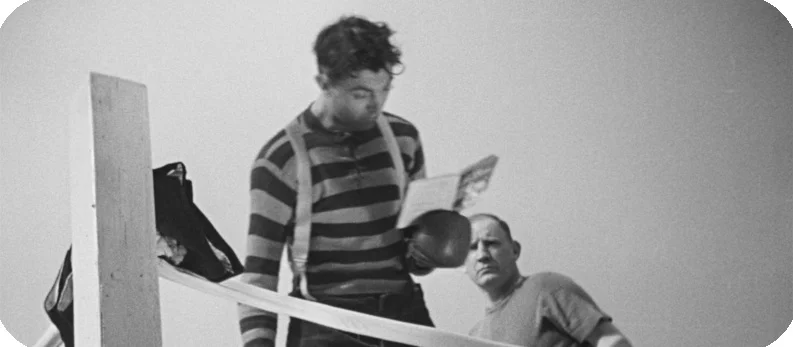
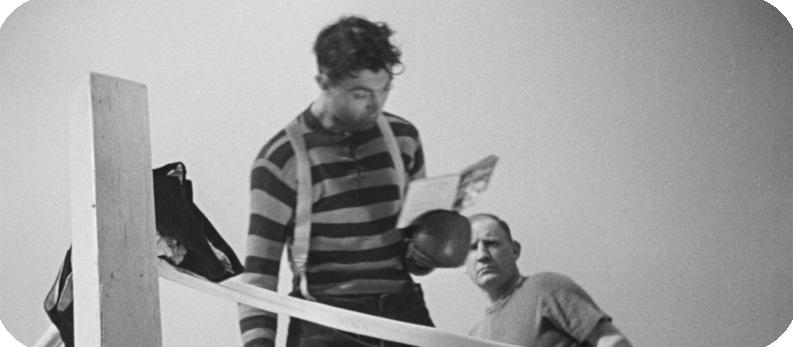
But reality and imagination prove at odds with each other. As he fights, Roger looks through a little booklet of boxing advice in the ring, and every time he adopts a technique, he takes a punch, turns around, and looks through for more techniques. It’s a gag repeated again and again — with only slight variation — and while it gradually wears thin (save a lovely twist where Roger mistakes a back cover advertisement for a fencing booklet for advice on a boxing stance), it’s given more attention than any other gag in the movie, and so must have been especially attractive to Tati. Perhaps it’s because every variation is a chance for a new pose, a new bit of physical comedy for the performer whose miming act “Sporting Impressions” was in the process of making him a music-hall star across Europe. But it may also have been a moment of recognition for Tati of one of his pet themes, that of the outsider trying to understand the proper way to emulate a social behaviour and inevitably failing and watching chaos ensue around him.
And so chaos does, for after the pro boxer unknowingly connects one of his punches to the postman, the latter stomps off to find people to help him retaliate, and finds two tough-looking farmers who don’t take kindly to people who attack helpless postmen. Soon five men are in a fistfight on the ring, whose cheap structure gives way and leaves them finishing the fight in a broken down shambles of a wooden frame.
While the cutting is at times a little too brisk for the leisurely pace of the plot and the truly graceful acting that Tati delivers, the short is well-crafted and offers a coherent artistic vision. Tati-esque touches abound in general. We may easily mistake the overeager postman for Francoise, the subject of Tati’s L'École des facteurs and Jour de fête; likewise, Roger resembles a slightly more sullen Hulot, curious, befuddled, and entirely good-natured. Unlike the earlier shorts, both of which used faster pace musical scores to create a frantic soundscape, Jean Yatove’s for Soigne is mostly more relaxed. Rather than a driving underscore, the soundtrack’s jovial, fair-like atmosphere is more in line with Tati’s eventual musical modus operandi, even if it seems likely Tati had no direct hand in influencing it. Consistent with that convivial tone, there is no villain here: Roger’s opponent is patient, indulgent, friendly even, and the brawl that destroys the ring is instigated by an accident. And like the Royal Garden restaurant in Playtime, when it collapses, it becomes an entirely new structure that is now better suited to Tati’s character than those around him, and he quickly claims a KO and a decisive victory. While the satirical import and mind boggling complexity of that late masterwork certainly aren’t present here, one can leave Soigne ton gauche with a far better-formed impression of the artist than Une brute or Gai dimanche!. The final image, more than any one moment before it, bears Tati’s unmistakable signature in its wistful ode to the imagination: a wide shot of the kid with the toy camera as he rushes to film the postman cycling away down a long road.
Other Essays in This Series
On demande une brute
Gai dimanche
Soigne ton gauche
Notes on Tati: Gai dimanche (1935)
While On demande une brute is by any standard a thoroughly clumsy work that neither conforms clearly to Tati’s pre-filmic mime act nor the tastes and interests he would come to display as the world’s pre-eminent master of cinematic high comedy, Gai dimanche is both an unmistakably formative work and a far greater success. The setup foregrounds the modus operandi that came to define Tati’s approach: breakdowns of human behaviour across class that show up the absurdity of social programming and how it pervades spaces of work and of leisure.

by Willa Ross
In Jacques Tati: His Life and Art (Panther), David Bellos mentions an anecdote in which Tati would claim the early shorts he wrote and performed in were funded entirely through his work in music-hall performances. As Tati told it, he would save some money, buy a few meters of unexposed film, and repeat the process. Bellos points out that his early shorts were either too expensive to entirely jibe with this shoestring funding story or made before he had any music-hall income to speak of. Given that these early shorts were such collaborative efforts (with directors, co-writers, producers, etc. working in what seems to have been a horizontal production structure), perhaps they represented a pooling of resources that had each party dredging up cash in their own ways, and one of Tati’s tasks was to purchase the footage. Whatever the truth of the matter, the anecdote stresses that these shorts were not cynical or merely desperate attempts to escape the challenge of making a living as a live performer in depression-era France; by all appearances they seem to have been labours of love.
While On demande une brute is by any standard a thoroughly clumsy work that neither conforms clearly to Tati’s pre-filmic mime act nor the tastes and interests he would come to display as the world’s pre-eminent master of cinematic high comedy, Gai dimanche is both an unmistakably formative work and a far greater success. The short centers on two homeless grifters who one day decide they’d like a day in the country, and set about to realize it by stealing a rickety 10-seater charabanc and charging tourists for a leisure tour, complete with meal and entertainment. The setup foregrounds the modus operandi that came to define Tati’s approach: breakdowns of human behaviour across class that show up the absurdity of social programming and how it pervades spaces of work and of leisure.
In an early scene, as the pair of con men search a car lot for a workable ride, one nearby jalopy seems to start up all its own; when they open the lid, they find a kid in the empty compartment, blowing against his lips and making believe that he’s an engine as he holds a steering wheel in front of him. They wordlessly close the lid and leave him alone. While the gag isn’t especially complex or surprising, its use of sound without a clear originating source — what Michel Chion called “acousmatic sound” — foreshadows Tati’s obsessive play with the source, perspective, and audience assumptions attached to sounds in his films, and the way that our expectations of sounds play into our instilled sense of proper behaviour. The reaction is equally telling: as we’ll see time and time again in his Hulot films, the typical reaction of onlookers to an outsider’s well-meaning transgressions is to ignore it. That reaction is often more absurd than anything done by the unwitting interloper, and it’s there that Tati finds the core of his humour, both in its famously gentle observation of foibles and its acclaimed satiric intelligence.
That gag, while formally interesting, is nonetheless slight; mildly clever but lacking in elaboration or depth. Much the same can be said for the rest of Gai Dimanche, whose best gags either have a ring of familiarity from silent comedies by Sennett, Chaplin, Keaton, and others, or from their development into far superior forms in Tati’s features. Indeed, while his personality is on clearer display, it wouldn’t be a stretch to say that Tati is less impressive than his co-star and co-writer (and close friend), Rhum. The scarce dialogue given to Tati is delivered with a positively leaden lack of energy, and while his physical performance once again shows the clear skills of a uniquely talented mime (particularly in a sequence where the two con artists make a spirited attempt to attract customers to their tour, then gradually deflate into dejection when nobody shows interest), Rhum is his near equal that regard, and his skill with rat-a-tat verbal delivery make him the de facto star of the short.
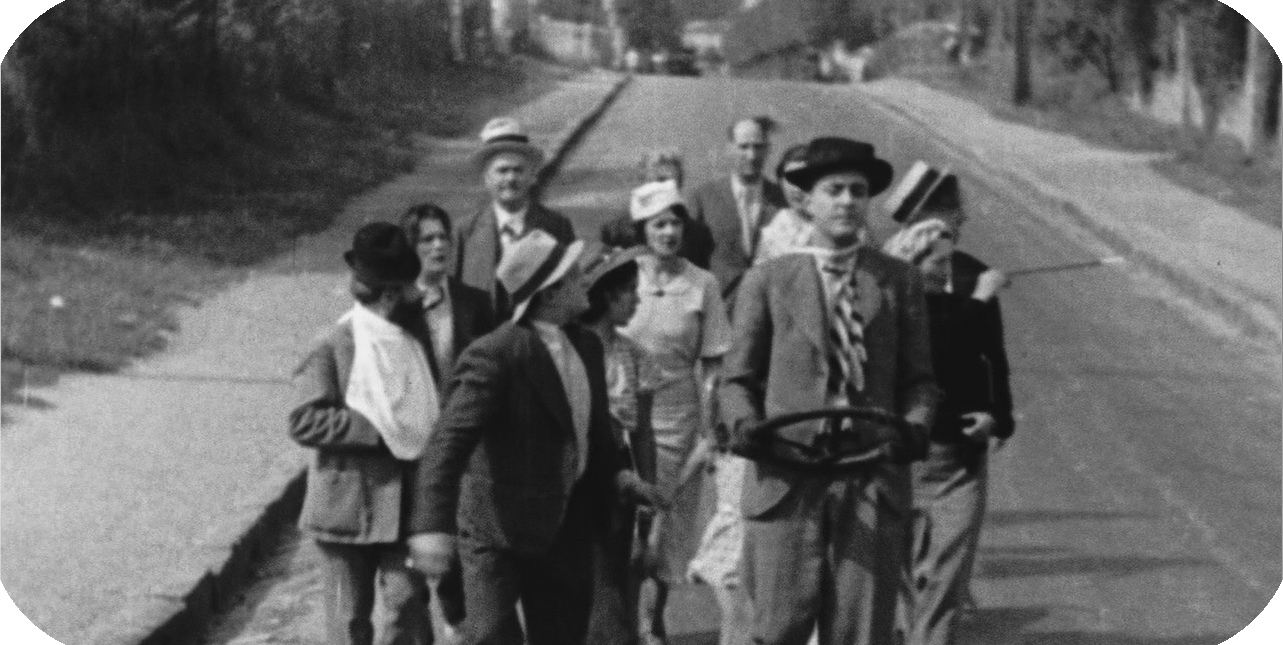
After the disastrous excursion plays out in scenarios both funny (a passenger’s legs breaking through his seat, forcing him to jog along the pavement as the charabanc drives on) and unfunny (a large woman has trouble getting up into her seat), the final gag shows Gai dimanche’s most Tati-esque side as well as its still-unformed comic voice: after a train obliterates the charabanc, the drivers and passengers walk back to the city on the road in the exact same formation as before, with Rhum pointing to the side and guiding the sightseeing tour as Tati grasps the detached steering wheel in front of him. It’s an amusing-enough articulation of people’s desire for routine and normalcy, and the paradoxically absurd results of that attitude. At the same time, the complete lack of indignation from even the most well-to-do of Tati’s and Rhum’s customers feels unconvincing. Tati would eventually recognize the resistance people tend to have to paradigm-shattering playfulness and endow it with a sense of pathos that elevated his Hulot comedies from amusements to masterpieces, but the partial gestation of his worldview visible here — especially when assisted by competent direction and far more involved sound design — makes for a fun Sunday viewing.
Other Essays in This Series
On demande une brute
Gai dimanche
Soigne ton gauche
Notes on Tati: On demande un brute (1934)
As the oldest surviving film to feature Jacques Tati, this provides an interesting ground zero for his talents, even if it's a pretty lousy cast-off of a comedy. Here, Tati co-wrote with Alfred Sauvy this short about a young, lanky actor named Roustabat, who has trouble getting cast, and whose domestic partner is constantly insulting him and his vocation. Meanwhile, a low-level fight organizer is having trouble booking an opponent for a wrestling match he's already sold out (nobody wants to fight his infamously brutish star fighter), and so he publishes in the newspaper a vague call for men "specializing in violent roles". You can probably fill in most of the blanks from there.

by Willa Ross
As the oldest surviving film to feature Jacques Tati, this provides an interesting ground zero for his talents, even if it's a pretty lousy cast-off of a comedy. Here, Tati co-wrote with Alfred Sauvy this short about a young, lanky actor named Roustabat, who has trouble getting cast, and whose domestic partner is constantly insulting him and his vocation. Meanwhile, a low-level fight organizer is having trouble booking an opponent for a wrestling match he's already sold out (nobody wants to fight his infamously brutish star fighter), and so he publishes in the newspaper a vague call for men "specializing in violent roles". You can probably fill in most of the blanks from there.
This makes direct show of Tati’s love of silent comedy — most obviously, in the fight sequence, Chaplin and his City Lights — but unlike his features that evolved a more open-ended structure to scenes, each vignette here takes on a clear comic premise by way of a sitcom-y point of tension. The use of sound is also not especially crucial to anything in the movie. In fact with the dialogue removed and a few intertitles added, On demande une brute would work as a silent. In some ways, it might even be better off in such a form: the music, a first-time score by Marcel Landowski, frequently competes with the dialogue, and heavily punches up most of the slapstick gags, leaving hardly any work to be done by sound effects.
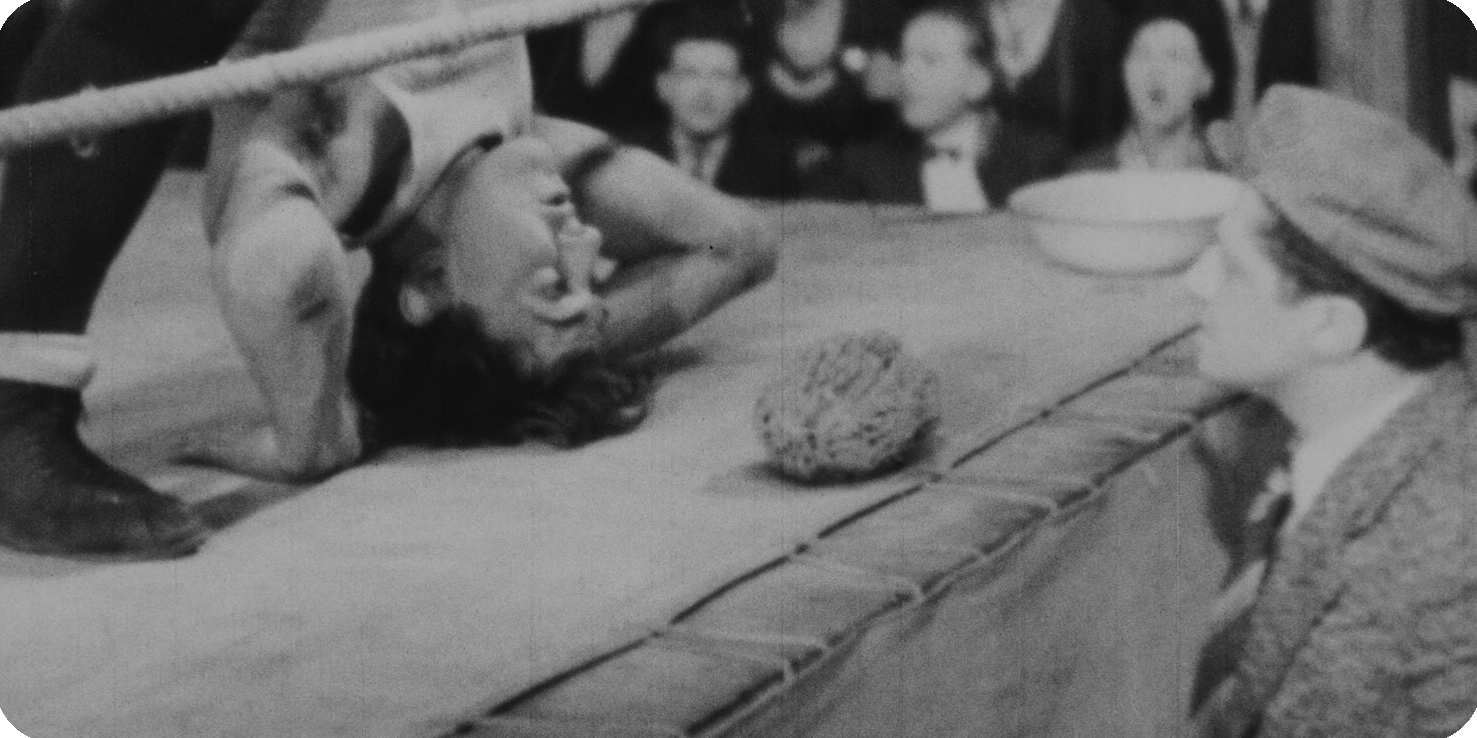
On the other hand, one of the most effective moments of the film comes when short, pathetic little crunch as the scene fades out. It’s a very Tati-esque use of sound by the director Charles Barrois, and one wishes he displayed the same light touch and attention to the most effective points of comic focus throughout the film. Sadly, he often drops the ball in this respect; not only are many of the cuts to reverse shots and close ups awkward and disorienting, but Barrois will frequently miss major opportunities for laughs. For example, just before the fight, as the announcer is still addressing the audience, someone accidentally hits the gong, and Roustabat’s opponent mindlessly charges the poor man in the middle of the ring, leading to a moment of chaos where several men have to pull it off. It’s a perfect moment to indulge in a closeup of Tati’s worried face as the punchline, but that fairly clear chance for a payoff never comes. Not that Barrois’s work has nothing to recommend it. Now and then a shot or series of cuts will show an interesting sense of staging or strangeness (as when Roustabat is hung upside down near the end of the ring and sees a face next to his ringside, and a series of cuts flip quickly between his POV and a right-side-up view of the man). But in the main it’s a visually disinterested, burdensome comedy, both stylistically anonymous and quite poor at emphasizing comedy.
I don’t want to give the impression here that Barrois fails because he fails to highlight Tati’s great performing ability, since Tati’s performance itself here is, shockingly, kind of lousy. While he shows some of the precise control over his body that would make him one of the most graceful physical actors there ever was, his sense of how to exploit little changes to the angles of his limbs, affect an entire personality in his gait or lean or cock of the head, or use tiny changes of facial expression to worldlessly communicate a universe of inner thoughts... well, that sense simply isn’t visible here. Instead, it’s a performance with a fairly game willingness to emphasize Tati’s stick-like figure and a lot — a shocking amount, really! — of mugging.
After Roustabat upsets the fight and wins (by cheating), he, his friend Mérandol (who smashed the other fighter’s head with a lead pipe), and his now-admiring wife head to a car outside. After the three disappear behind the vehicle, it drives off and leaves his formerly-nagging wife behind. It’s a surprisingly mean-spirited ending for the future auteur whose own films would only gently mock the vices and pretensions of others. It may be one of the best-staged gags in the movie, but that ought to lend you a sense of how low the bar is set here. It’s a mostly good-natured and well-intentioned film (short of the caustic depiction of its only female character and a scene that makes rather cruel use of a live fish). That it was made by a combination of upstart professionals and rank amateurs to film (the latter category including Tati himself) accounts for its issues, though when viewed an early attempt for the destitute-at-the-time Tati to break from the music-hall into motion pictures, there are hints of his future output’s ethos, in particular a sympathy for the dim, hapless, and incurably uncivilized but thoroughly well-meaning outsider.
Other Essays in This Series
On demande une brute
Gai dimanche
Soigne ton gauche
FILM FORMALLY
Film Formally gets granular about how movies work by choosing a technique or trait and studying it through its best examples. Every Tuesday, Independent filmmakers Devan Scott and Willa Ross leverage years of watching and making movies to bring you spirited and approachable conversations, offering brick-by-brick analysis and discussions about how movies work.
Associate Producer: Paige Smith
Current season edited by Amanda Avery
Got an idea? A guest you’d like to hear from? Give us a shout at filmformally@gmail.com.